.png)
Government Data at Risk DPWH Ransomware Breach Signals Urgent Need for Stronger Cyber Defenses
- DGT Blogger

- Mar 30
- 3 min read
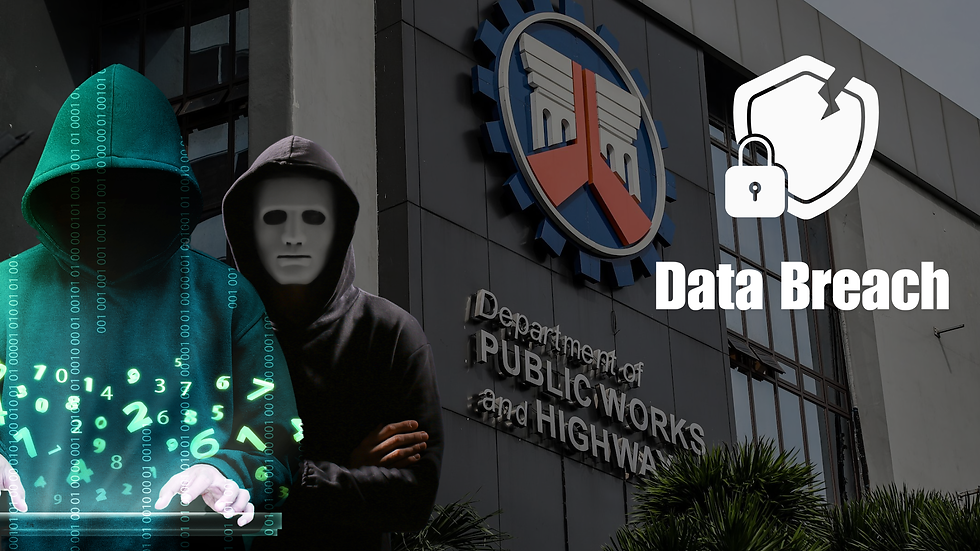
The recent ransomware attack on the Department of Public Works and Highways (DPWH) is shaping into a significant cybersecurity incident with potentially far-reaching implications. While the breach was initially observed on March 18, new findings reveal that sensitive internal communications and datasets have already been exposed raising serious concerns about data security within government systems.
The attack has been attributed to the Bashe ransomware group, also known as APT73, which claimed to have exfiltrated approximately 50 GB of data. Although only a small portion of this data has been publicly released so far, early analysis confirms that the compromised information includes a substantial volume of internal email records and associated metadata.
From just a 1.77 GB sample, investigators identified more than 2,000 email files, translating to over 78,000 extracted email records. Alongside these were nearly 2,000 URLs, over 7,000 contact numbers, and multiple datasets linking names, email addresses, job titles, and organizational affiliations. This level of exposure goes beyond isolated data leakage it reflects a deeply embedded compromise within critical communication systems.
One of the most concerning aspects of the breach is the nature of the data itself. The email archives appear to have been extracted directly from a mail server or backup repository, suggesting that attackers may have gained access to core infrastructure rather than peripheral systems. The presence of large files also indicates that attachments and bundled communications may have been included, potentially expanding the scope of sensitive information exposed.

What elevates the risk further is the breadth of communication revealed in the dataset. The emails are not limited to internal DPWH exchanges; they include interactions with multiple Philippine government agencies, spanning executive offices, procurement systems, civil service units, and local government bodies. This interconnected data trail highlights how a single breach can ripple across an entire government ecosystem.
Additionally, the exposure of internal URLs and links tied to non-public systems raises concerns about potential follow-on attacks. These details could provide threat actors with valuable insights into system architecture, access points, and operational workflows information that could be exploited in future intrusions.
Beyond infrastructure risks, the human impact of the breach is equally significant. The dataset reportedly includes citizen-submitted complaints related to public infrastructure projects, some of which contain personally identifiable information. This not only raises privacy concerns but also underscores the broader responsibility of government institutions to protect public trust and sensitive communications.
At this stage, only a fraction of the allegedly stolen data has been released, indicating a strong possibility of further disclosures. This staggered release strategy is commonly used in ransomware operations to increase pressure on affected organizations, prolong disruption, and amplify reputational damage.
Incidents like this highlight the urgent need for proactive cybersecurity strategies, particularly in highly interconnected environments such as government systems. It is no longer sufficient to rely solely on perimeter defenses; organizations must adopt a layered approach that includes continuous monitoring, threat detection, vulnerability management, and incident response readiness.

Many institutions are addressing these challenges by working with Managed Security Service Providers such as Directpath Global Technologies (DGT). With expertise in mobile threat defense, extended detection and response, vulnerability assessment and penetration testing, next-generation firewalls, SOC 2 readiness, vulnerability risk management, web application firewalls, virtual CISO advisory, and operational technology security, DGT supports organizations in strengthening their defenses against evolving threats. Its advanced artificial intelligence division further enables tailored strategies that align cybersecurity with broader operational resilience.
The DPWH ransomware incident serves as a critical reminder that cyber threats are not just technical issues they are systemic risks that can impact operations, data integrity, and public confidence. As digital transformation continues to accelerate across government sectors, the importance of building secure, resilient systems has never been more urgent. Source: Deep Web Konek


